It seems that about this time of year I am always writing a post about diversity but yet here I am again talking about it. Not just because today is the Day of Pink but because I think that this is a very important topic to be discussing. (last years post)
I want to first start out by saying in no means am I trying to offend but to provoke your thinking. I truly believe that we all have our students learning and feelings at heart. We want what is best, no matter our believes.
As I mentioned above, today is the International Day against Bullying, Discrimination, Homophobia, and Transphobia across the world. Now I know that many of us are very comfortable about teaching or stopping bullying and discrimination; especially when it comes to race. I mean we don't debate slavery anymore do we? We recognize that this is wrong but what about homophobia, and transphobia? Are we just as ready to stand-up for this discrimination?
I already know the answer and for many of us it is no. I know this because I was there. I wasn't ready to do this. I know that before I learned more about discrimination that was the case. So what changed?
For me it was a realization that what I was doing was wrong. Yes, wrong! If I was prepared to stand up for what was right for other forms of discrimination why not for discrimination against the LGBTQ communities? I started learning more from a great friend and colleague Alicia Gunn. Along with her wife Shannon (@gunnteach) I learned so much about all social justice ideas and ALL forms of discrimination. I started to change my practise to teach my children how to be the difference in the world. And I slowly learned that its never the kids who have problems with this; its often the adults.
Kids don't see differences. I mean they notice them but they never really care about them. All they really care about is how they are treated. This should be the focus. As one of my students said the other day, "We are all human so let's treat each other that way!"
I totally understand that there is a lot of factors: Religion, personal believes, being uncomfortable, and or not knowing enough. However, as I said before we don't debate slavery so why this? How is this any different then any other form of discrimination? Is it because of religion? Is it because of the backlash? Discrimination is wrong. Period. If we as teachers, parents and adults don't start modelling this then we are creating a cycle of hate. We are the ones who are responsible for creating the wars and terrorism that is happening in the world. We are responsible for the violence that we are so ready to shake our heads at. WE, no one else!
WE as teachers need to stand-up for what is right, to be the models that our kids look up to. I don't know about you but I don't want to be the reason for perpetual violence happening in the world. I want to be the difference that makes this stop?
So how do we do this:
The first step is recognizing that diversity starts with you. We have to put our personal believes and feelings aside and realize that its about love and not hate. It's understanding that I know some parents may be offended because they don't understand but it is my job to educate and make them see this difference. Its not easy but we healthy relationships and if ALL of us are doing it, it makes it a lot easier.
Second step is that this can't just be a one day event. Social diversity needs to be incorporated into our programs whenever we can. To be honest these social justice topics are so easy to incorporate into any subject matter. They also create a real powerful context that our students can latch on to and as we know research shows that when students have powerful contexts to learn with they learn a lot better.
I would love to here from anyone about how they incorporate and celebrate diversity in their classroom. Also if you have any questions please ask away. Love to hear your comments and ideas.

This blog is about my amazing learning as a teacher this includes my personal thoughts and reflections on education and the learning that happens in my classroom. You can find my resources at www.bit.ly/Soresources
Showing posts with label teacher impact. Show all posts
Showing posts with label teacher impact. Show all posts
Wednesday, 8 April 2015

Monday, 3 November 2014
A Reflection on Assessment

The discussion came about when Brian made a post about a brand new app call Photomath. Basically its an app that can do algebraic equations for you. The question that Brian raises is what are we assessing when an app can do the math for us? Should we be assessing basic skills like this?
My response to this was there needs to be a shift to not what is the answer but how do you know the answer is correct. It reminded me of the calculator debate when I was in school. I still remember this movie we had to watch in grade eight and the two children were adding up some money. One of the girls takes out a calculator and clearly gets the wrong answer but strongly argues that she is right. When asked why, she states because the calculator told me. It turns out that the calculator was running low on batteries and if you used basic common sense then you would have known the answer was wrong. The point wasn't so much that she got it wrong but that there was faith in the answer because the technology told her so. The problem is that students then and now need to have a good conceptual understanding of the work before jumping into abstract thinking. They need to understand the process in learning.
The world has changed a lot since we were in school, heck even since I was in school (which to be fair was not that long ago). If you honestly look back and think about those school days, the information that we were given potentially would have lasted us our life time. To be fair the information our parents were taught did last them their lifetime. However, that is not so with the kids we are teaching. Technology has changed the way we use, process and understand the world around us. We live in a world were tomorrow has endless possibilities. The scary part is that I am preparing kids for a future with obsolete information and knowledge. Which is why philosophies on assessment have drastically changed.
A couple of years ago I was giving a test to my students. I looked up and saw that my students went right to talking with their math partners, trying to solve the questions. I was about to stop them and state that this is a test I need to know what you know when I realized that I already knew what they knew. Because of teaching in a constructivist approach, I knew where they were struggling, what strategies they would answer, and how they would communicate. In fact I knew why certain students were talking and asking questions and I knew what next steps would be useful for them. This test wouldn't tell me this, in fact it was wasting two hours of time that I could be conferencing with my students and helping them move forward.
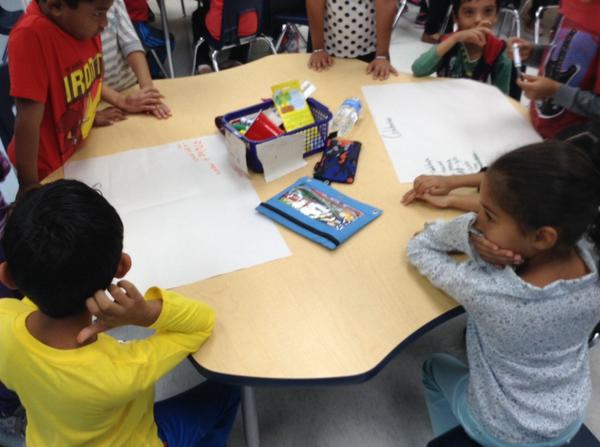 |
| Students collaboratively working on creating success criteria for an assignment |
Now I said I knew a lot, why? The reason is that in my teaching I am always conferencing with students, individually, and in groups. I have honest conversations with them and ask them questions to test their knowledge. Based on their responses and work samples I am able to see where fit on a continuum of learning. In fact I can confidently say that I understand my students more from this method then I do with a summative assessment like a test that I would have traditionally given. Not only that but my students move faster up that continuum because of our conferences and reflections that are done everyday versus just studying for one test to then forget about it the next day.
For me it is more important to teach my students to be curators or data, critical thinkers, problem solvers and have creative/adaptable thinking skills. I say this because the information I am teaching them will soon be obsolete. Now please don't get me wrong and say that students don't need to have basic skills or test taking abilities. Unfortunately in this school system and society they still need those test taking skills and yes students do need to learn basic skills (arithmetic, writing, reading, etc.) but the emphasis shouldn't be on memorizing to retain for an hour but to go deeper with that thinking and be able to understand why we are using it not just knowing and forgetting.
This brings me to my questions and ones that I hope everyone help can answer:
1) What assessment tools do you prefer and use in the classroom?
2) What skills are needed, as a teacher, to make assessment as and for learning effective for growing student achievement?
3) What do you think about the shift in assessment? Is it warranted? needed?
4) If we are moving to a more assessment as and for learning, how to we do this?
5) What is the biggest resistance to this change? How do we over come it?
I am really excited for this conversation as I think we are on the brink of exciting change in education. Would love to hear your comments and ideas about this topic, no matter what they are.
Wednesday, 21 May 2014
Why do we Need to Argue over Math? --> A Call for a Balanced Approach
About a month ago a colleague of mine Kyle Pearce wrote a post "Does memorizing multiplication facts hurt more than help." It was a very interesting read and I happen to agree with Kyle's point of view. As many of my frequent readers of this blog know, I prescribe to the constructivist approach to learning mathematics. I believe that students through discovery and proper guidance will be able to understand a wide load of big ideas and theories. Not only do I believe this but I have witnessed this first hand with my students in every grade that I have taught.
However, this is not so for many people. In fact it was a discussion on Kyle's blog post (feel free to read the thread) that has me thinking more and more about this topic. And not only thinking about it but trying to fix and insight thoughtful discussion around the ways in which we are teaching math.
Maybe a little background first. Math has been a hot topic for the past year, if not for the last century. For many countries, provinces, and states, math curriculum has undergone a significant change from what we grew up with as children. Some. like myself, believe that these changes are for the better, some have not. I was recently at the OAME and listening to Brent Davis a professor at University of Calgary. In his lecture he shared that the reason math curriculum was introduced was so we could have a work force to crunch numbers, nothing more and nothing less. As we have evolved beyond that (not saying fact crunching is not important) our skills have also changed and I think this is what we need to remember; we have evolved.
For this reason I and many others are proposing a more balanced approach to mathematics. Lets stop this war and needless debates and get to teaching good mathematical practises. One in which our students will push their thinking and really think about the numbers.
If it was up to me this is what I would include:
1) Math should be linked to Big Mathematical Ideas:
I think this is the first step to thinking about our students as mathematicians. Catherine Fosnot (2002) has some very interesting work around making our students mathematicians. One of the most interesting facts is there was a study done with so many mathematicians and they were asked to solve a problem. Not one of those mathematicians solved it the same way. I found this interesting because that is what I see math. Math is about the mathematics and there is not one way of doing things. We have to teach our students the understanding, the flexibility and the patience to be mathematicians.
2) Math is about real numbers:
Students need authentic experiences to learn. Let's think about ourselves and how we learn. Now some do learn through reading and replication but if you honestly think about how you learn a concept the best; it is through trail and error and than guidance from a mentor. This is the same for our students. They need real experiences so that they can play and discover the mathematical concepts. In my personal experience both in tutoring high school students and teaching mathematics in the primary and junior divisions it's the contexts that allow students to really understand what they are doing. It's the context that helps them build models of representation. In my classroom, these are often done through social justice problems and real life contexts.
3) Students need time to explore:
This goes hand in hand with the above comment. As much as we need instruction, we also need exploration. Students need time to make mistakes, reflect, debate and discuss. These experiences allow students to make connections between concrete and abstract thinking. I was reminded at the OAME that every mistake makes a new synapse in the brain. We need these mistakes I order to solidify our learning.
4) Students need Mentors:
However, this is not so for many people. In fact it was a discussion on Kyle's blog post (feel free to read the thread) that has me thinking more and more about this topic. And not only thinking about it but trying to fix and insight thoughtful discussion around the ways in which we are teaching math.
Maybe a little background first. Math has been a hot topic for the past year, if not for the last century. For many countries, provinces, and states, math curriculum has undergone a significant change from what we grew up with as children. Some. like myself, believe that these changes are for the better, some have not. I was recently at the OAME and listening to Brent Davis a professor at University of Calgary. In his lecture he shared that the reason math curriculum was introduced was so we could have a work force to crunch numbers, nothing more and nothing less. As we have evolved beyond that (not saying fact crunching is not important) our skills have also changed and I think this is what we need to remember; we have evolved.
For this reason I and many others are proposing a more balanced approach to mathematics. Lets stop this war and needless debates and get to teaching good mathematical practises. One in which our students will push their thinking and really think about the numbers.
If it was up to me this is what I would include:
1) Math should be linked to Big Mathematical Ideas:
I think this is the first step to thinking about our students as mathematicians. Catherine Fosnot (2002) has some very interesting work around making our students mathematicians. One of the most interesting facts is there was a study done with so many mathematicians and they were asked to solve a problem. Not one of those mathematicians solved it the same way. I found this interesting because that is what I see math. Math is about the mathematics and there is not one way of doing things. We have to teach our students the understanding, the flexibility and the patience to be mathematicians.
2) Math is about real numbers:
Students need authentic experiences to learn. Let's think about ourselves and how we learn. Now some do learn through reading and replication but if you honestly think about how you learn a concept the best; it is through trail and error and than guidance from a mentor. This is the same for our students. They need real experiences so that they can play and discover the mathematical concepts. In my personal experience both in tutoring high school students and teaching mathematics in the primary and junior divisions it's the contexts that allow students to really understand what they are doing. It's the context that helps them build models of representation. In my classroom, these are often done through social justice problems and real life contexts.
3) Students need time to explore:
This goes hand in hand with the above comment. As much as we need instruction, we also need exploration. Students need time to make mistakes, reflect, debate and discuss. These experiences allow students to make connections between concrete and abstract thinking. I was reminded at the OAME that every mistake makes a new synapse in the brain. We need these mistakes I order to solidify our learning.
4) Students need Mentors:
My most recent research in understanding teachers questions has shown me the importance of teachers, not that I didn't believe that before. With a shift towards discovery learning, we as educators have forgotten the importance of our role, or what even our role is. I truly believe that we should not be the dispenser of knowledge but the mentor of that knowledge. Though through exploration students will learn (many studies to show this) they may not have tools to reflect or pull together the big ideas. I think this is where much of the back lash has come from discovery math, reform math or whatever you want to call it. As students explore and discover there needs to be some sort of guidance. This is where a teacher can shine and help students with the mathematics. However, my research shows that for this to happen, a teacher needs to 1) have a good understanding of mathematics, 2) have a good understanding of how children learn mathematics and 3) plan. I know that all teachers plan but this planning involves thinking of big ideas, landscapes and possible questions. It is these questions carefully placed that can allow students to figure out and make mathematical connections.
Take a look at this video of three of my students thinking about fractions.
They have never been taught fractions from me before this and in fact as a class we haven't even started the unit. However, that being said think about their learning and the role they play and the role that I play as a teacher. Where do my questions come from? Why did I ask them at the time I did?
They have never been taught fractions from me before this and in fact as a class we haven't even started the unit. However, that being said think about their learning and the role they play and the role that I play as a teacher. Where do my questions come from? Why did I ask them at the time I did?
5) Time for debating, conjecturing, discussing and proving:
For me this is the time for a teacher to shine; however not in the traditional sense of standing in front of the class and lecture or tell students how it should be done. Just like students need time to explore they also need time to debate as a community. It is through this debate that students defend their thinking, conjecture, question and solidify their learning. Moreover, it goes beyond just showing and telling. As a teacher the types of strategies that you show matter. How are you building the learning up, what questions are you modeling? How are you focusing the talk? How are you fostering talk? These are all questions that a teacher needs to be asking.
A great article to read is: https://drive.google.com/file/d/0B4245QONE7HaSExrSUlWTjBrNEU/edit?usp=sharing
Also take a look at my most recent grade two conversation of multiplication.
6) Repeated Practise:
6) Repeated Practise:
Yes I said repeated practice! Students need it, but it's not just doing procedural learning over and over again. When I say repeated practise I mean a similar problem for students to continue their exploration. Students, well most students, cannot solidify their learning through one experience. In a typical unit my students will solve about 7-8 problems that could take three to four weeks to learn. These problems build their learning and knowledge from day to day.
7) Skills:
7) Skills:
Yes skills are important. They are needed but they are not needed like we use to think about it. For me it's how are we introducing facts. Do we make students think through facts? Are they taught in isolation or allong with concepts? In my classroom, students practise facts at home, they play math games in the classroom (here is a file of my math games: https://drive.google.com/folderview?id=0B4245QONE7HaaHl3M3ZKNWd3SUk&usp=drive_web). In addition before my problems start I often use string lessons which builds on mental math strategies and learning how to be flexible thinkers and playing with numbers. This to me is more important then struck memorization. It teaches students that numbers are not confined facts but that you can pull apart numbers and use known facts to solve other facts. Through this process students often learn all of their math facts, can recall them and use them in problems, which to me is way more important.
These are just a few of my thoughts on what I am calling a balanced math approach. I have a few more to hash out around integrating and implementing a center approach within my problem solving approach.
What are your thoughts? Don't you think it is better to discuss and fix our problems rather than lay blame about which is better? Shouldn't we think about our students first and their needs in their 21st century world? Love to here your thoughts.
What are your thoughts? Don't you think it is better to discuss and fix our problems rather than lay blame about which is better? Shouldn't we think about our students first and their needs in their 21st century world? Love to here your thoughts.
Subscribe to:
Posts (Atom)