Showing posts with label trajectories. Show all posts

Monday, 3 November 2014

A Reflection on Assessment


In a couple of days I will be presenting at Bit14 with Aviva Dunsiger. Our presentation is bridging the divide: Opening our four walls. However, I digress from my blog title. The reason why I am writing this is because I was also asked to co-facilitate a discussion with Brian Aspinall on assessment in a changing 21st century learning. This is going to happen on Thursday at 10:00 in the learning commons.  It is a free forming discussion but I thought I would get the ball rolling with some of my own thoughts and more importantly questions.


First of all with our assessment document in Ontario (Growing Success) there is a big emphasis on assessment for learning, as learning and of learning; with a large focus on assessment as learning and for learning. This is a big shift for many of us teachers who before this did a lot of assessment of learning. Not to say that this isn't important but that there has been a big shift in thinking about assessment.  This shift also aligns strangely enough with a wider acceptance on qualitative data versus quantitative data.  That observations and discussion are just as valid and important as the number that we can collect.  Which brings me to the reason for our learning commons discussion.

The discussion came about when Brian made a post about a brand new app call Photomath. Basically its an app that can do algebraic equations for you. The question that Brian raises is what are we assessing when an app can do the math for us? Should we be assessing basic skills like this?

My response to this was there needs to be a shift to not what is the answer but how do you know the answer is correct. It reminded me of the calculator debate when I was in school. I still remember this movie we had to watch in grade eight and the two children were adding up some money. One of the girls takes out a calculator and clearly gets the wrong answer but strongly argues that she is right. When asked why, she states because the calculator told me. It turns out that the calculator was running low on batteries and if you used basic common sense then you would have known the answer was wrong. The point wasn't so much that she got it wrong but that there was faith in the answer because the technology told her so. The problem is that students then and now need to have a good conceptual understanding of the work before jumping into abstract thinking. They need to understand the process in learning.

The world has changed a lot since we were in school, heck even since I was in school (which to be fair was not that long ago). If you honestly look back and think about those school days, the information that we were given potentially would have lasted us our life time. To be fair the information our parents were taught did last them their lifetime. However, that is not so with the kids we are teaching. Technology has changed the way we use, process and understand the world around us. We live in a world were tomorrow has endless possibilities. The scary part is that I am preparing kids for a future with obsolete information and knowledge.  Which is why philosophies on assessment have drastically changed.

A couple of years ago I was giving a test to my students. I looked up and saw that my students went right to talking with their math partners, trying to solve the questions. I was about to stop them and state that this is a test I need to know what you know when I realized that I already knew what they knew. Because of teaching in a constructivist approach, I knew where they were struggling, what strategies they would answer, and how they would communicate. In fact I knew why certain students were talking and asking questions and I knew what next steps would be useful for them. This test wouldn't tell me this, in fact it was wasting two hours of time that I could be conferencing with my students and helping them move forward.
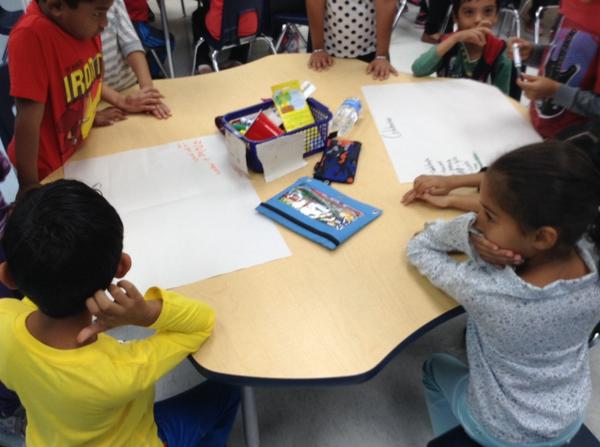
View image on Twitter
Students collaboratively working on creating success criteria for an assignment

Now I said I knew a lot, why?  The reason is that in my teaching I am always conferencing with students, individually, and in groups. I have honest conversations with them and ask them questions to test their knowledge. Based on their responses and work samples I am able to see where fit on a continuum of learning. In fact I can confidently say that I understand my students more from this method then I do with a summative assessment like a test that I would have traditionally given. Not only that but my students move faster up that continuum because of our conferences and reflections that are done everyday versus just studying for one test to then forget about it the next day.

For me it is more important to teach my students to be curators or data, critical thinkers, problem solvers and have creative/adaptable thinking skills.  I say this because the information I am teaching them will soon be obsolete.  Now please don't get me wrong and say that students don't need to have basic skills or test taking abilities. Unfortunately in this school system and society they still need those test taking skills and yes students do need to learn basic skills (arithmetic, writing, reading, etc.) but the emphasis shouldn't be on memorizing to retain for an hour but to go deeper with that thinking and be able to understand why we are using it not just knowing and forgetting.  

This brings me to my questions and ones that I hope everyone help can answer:

1) What assessment tools do you prefer and use in the classroom?

2) What skills are needed, as a teacher, to make assessment as and for learning effective for growing student achievement?

3) What do you think about the shift in assessment? Is it warranted? needed?

4) If we are moving to a more assessment as and for learning, how to we do this?

5) What is the biggest resistance to this change? How do we over come it?

I am really excited for this conversation as I think we are on the brink of exciting change in education. Would love to hear your comments and ideas about this topic, no matter what they are.

Friday, 22 November 2013

Learning progressions or trajectories

Lately I have been reflecting on this word or really concept, learning trajectories or progressions. I first came upon the word when doing research for my thesis. We often have seen these before. Many teachers may be familiar with the ESL stages, first steps, Fosnot and Dolk's landscapes of learning, but yet when I say this word many of my colleagues kind of stare at me blankly as if I had two heads. This got me thinking, maybe I should just blog about it.

What are learning trajectories?

A learning trajectory is just want is said, a trajectory or pathway that students take to learning.  This pathway can take many different pathways and is often not linear.

Why is this important?

I think that as educators we have to consider learning trajectories in our planning and in our assessment.  They help us create questions and next steps. They also can help you plan mind on activities, problems for students to work with and help you anticipate problems that may arise in the lesson.  If your into Covey, it's really beginning with the end in mind.  It allows you as an educator to see the different pathways that students may take in reaching the end goal.

How do I use trajectories?

As I mentioned above, trajectories can be used for a variety of purposes.  I like to use them for three purposes:1) anticipation, 2) questioning, and 3) assessment, both for, as, and of learning.  

1) Anticipation: anticipation is an important part of planning and unit or lesson. It allows me to see where my students may have problems, which in turn lets me ask critical questions to move them along the trajectory. By understanding the stages of development I can see the possible potential learning for my students

2) questioning:  Questioning continues to be an important part of teaching. Often though, and I am guilty of this too, we find our selves asking questions just to reassure us that the learning is happening and not to promote further discussion or learning.  By having a trajectory we can ask critical questions in the moment. It allows us to see where a student is and where they possibly can go.  Without it we are more reactive to the students learning instead of being proactive. 

3) Assessment: by having a trajectory I have done my assessment. It is right in the trajectory. All of my learning goals laid out, all my next steps and big ideas. Everything is in a learning trajectory. Often I have one for each students and I make my notes right then and there, no need for rubrics, tests, checklists. A trajectory has all of this included.

How do we find them/ create them?

When I first started using trajectories for learning,me often used the ones that were already made, why reinvent the wheel if it's already done. But the more that I observed student learning the more that I saw how stud penny's developed learning.  To create it, just think about the most basic step or big idea that a student would use. Then think of the next step.  As you work through a problem make notes and the next time it will become easier.  If you really have time, read the research as it will help you.

As I mentioned above, there are many different learning trajectories out there. I know for math I often use the work of Fosnot and Dolk and their landscape of learning. John van de walle has many interesting trajectories in his book, elementary and middle school mathematics.

As I finish my thoughts here, just wonder how many of you use trajectories and if so for what purpose?