Showing posts with label communication. Show all posts

Monday, 22 September 2014

"How are they doing?" Famous words said by every parent, ever thought why?

Famous words of every parent during meet the teacher night and words that many of us teachers cringe at.  For me I always felt that the students should be able to articulate this point of view to the parents, and to some degree I still do; however, I was picking up my daughter for the first time from school the other day and had to use every muscle in my body to stop myself from saying, "How is Izzy doing?"

This got me thinking: Even though, I knew my philosophy on this and yet I still wanted to ask those dreaded words. Why? Because I truly wanted to know how she was doing?  

Its been an interesting phenomenon having my daughter enter the world of school. I mean I know how she reacts at home, I know how she learns and yet when she is off in a different time and space then I wonder how she truly is doing? 

Million questions run through my mind: How is she behaving? What is she learning? How can I help at home to make it smoother? etc. Its a lot of stress and anxiety to have. As a parent all you want is the best for your child and I know that teachers will always give their best for my daughter but I also know its a very difficult job. I also know my daughter and I really just want to help. 

And lately this has gotten me thinking about my own students and their parents. What do they feel like when they drop their children off at school? Are they wondering about the same types of things (most likely yes). 

Now I know that we as teachers will often have interviews for students of concern or with parents we need to talk to, or we often see parents outside on the playground and say hey they had a great day but I know from experience that this doesn't really alleviate the stress of wondering what your child is actually going through every day.

With this in mind it has gotten me thinking about how can I alleviate this anxiety? So here is my plan:

1) continue using twitter and storify in the classroom.  In know that in previous post I have talked about this but these are amazing tools to have the parents see into the classroom. However, they don't necessarily give a picture of a particular child's strengths and next steps; just what they did and lately questions that can help with home.

2) So here is my insane idea, monthly summaries for each student.  Now I know many of you are thinking that this means more work for you as a teacher but I don't want to write them just give time for them to be completed. 

My biggest concern as a parent is what is she working on, and how can I help at school. Having these monthly reports would be, at least in my opinion, a great way of communicating this. This also will coincide with our schools philosophy of goal setting and making those goals public.  Now I am also about not making more work then what is needed. I have a new born and my own daughter that I want to spend time with. I mean as we speak I am writing this blog as my daughter is having a bath. So how can we make this work?

Conferencing has been always been an important part of my teaching but even more so now.  My goal is always to meet with the students four times a month.  During these meetings we discuss: reading goals, reading levels, math strategies, next steps, and classroom questions.  My thinking is that we turn these conferences back on the students and once a month we write down what we worked on this month, what our reading level is, where we would like to be and what our next steps are.  I was also thinking of adding in a parent connection where I can or students write what they would like to see at home.

3) I want to send home weekly good news. I hear this all the time in other amazing classes and I keep saying that I am going to do this but I really will now. Every week I want to send home five good news tickets, telling parents what amazing things that their child has done. Doesn't have to be academic just something that they can be proud of.  Now this may be a little more work but I think it would be worth it to build that community and trust.

4) Quarterly classroom visits: Now this is something that we already do.  Twice a term I want to invite the parents into the classroom during the day so their child can talk to them about what they are learning. This will primarily be on #geniushour but it can also be on any other topic.
I have learned more and more how important this connection is between the teacher and parent.  As my daughter starts her career in school, I and my wife just want to be a part of it.  She is our child and all we want is success.  Creating this team dynamic will only help her's and our student's success. 

Now this is a work in progress I am not too sure if it is logistically sound but I think it will work.  What do you think? Have you experienced this personally? What do you do in the classroom to communicate with all of the parents not just the ones that struggle? 

Monday, 2 June 2014

My 2ndish attempt at using provocations

I would like to think that I teach through Inquiry.  I really try to keep all of my work about the kids and their thinking; however, I do find myself still leading discussions more than I would like.  Then I learned about provocations.  WOW! I know that I have previously blog about this subject but since that time I have tried to use them more.  Today in science I did just that (at least I hope I did).

Here is what I did:

1) I got a bunch of experiments working on air and water

Center 1: AIR


Center 2: Water

Embedded image permalink
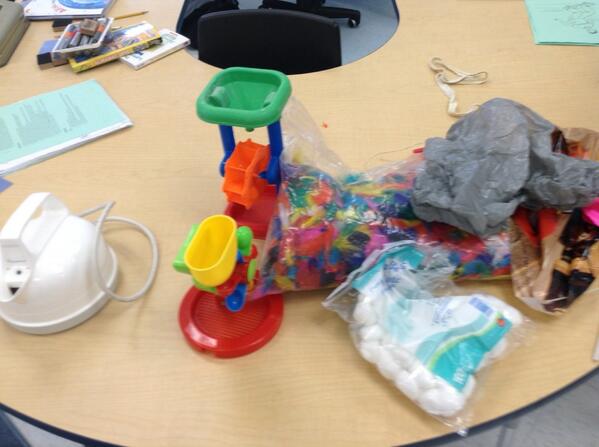
(note: some of these items were for other provocations)

Center 3: Water Cycle


Center #4: Pollution


I then broke them into groups had books and iPads at the centers and asked them what do they observe?  Wow, I couldn't believe the talk, the focus, and  the engagement.  Take a look at this shot:


Here the students were so engrossed in what was happening that they didn't even notice me.  They were saying, "cool look its raining!"  They were also using the vocabulary that we have been building before this through our watercraft project.

What did I learn?

1) Inquiry (true inquiry) is allowing planned exploration.  Students really need time to explore and make observations about the subjects.

2) This takes a lot of planning.  I been planning this for some time now (many thanks to my amazing PLN for their help in this).  As I have been planning I had to think about questions, get all of the materials ready and even think about possible misconceptions.

3) True assessment.  I was amazed at what the students had absorbed through previous books, the Watercraft project and our discussions.

4) Its a lot of fun to watch the joy and engagement of true learning

So if you haven't done provocations before, give it ago.  Its a lot of fun and you would be surprised at what you will learn about your students.


Wednesday, 8 January 2014

Geometry

I started this blog to talk about the things I did in my classroom but it has turned into more of ramblings on education; however, this blog post I want to focus on some things that I have been doing in the classroom with my grade twos.  

As I have stated before, I predominately teach through inquiry and problem based learning especially in math.  Rarely, if at all, will you find me lecturing, I just don't think kids want to hear me ramble or that they are really listening. Instead I try to facilitate discussion through activities, problems, projects and carefully planned questions.  However, there are still some subject areas that I have trouble with, geometry is one of them.  The reason I struggle with this is it's sometimes really hard to come up with a context or a problem that allows students to explore the concepts that you are teaching. Not only this, but there is a lot of vocabulary, or social constructs as I like to coin it, that students just need to learn (e.g. The name of a four sided shape is a quadrilateral). Moving to primary has allowed me to shift my thinking nd find more ways to explore these concepts.  I have had to revisit many of my favourite resources, like VanDeWalle, Marilyn Burns and Fosnot. VanDeWalle has an amazing learning progression for geometry in his book.

Here are some of my activities: 

1) concept attainment: yes and no categories

For this activity, I had a bunch of 3D figures or shapes for students to see. I placed one object in the yes and then another in the no. I would then have the students discuss what they think is happening.  I would then place another object in the yes and no category.  Once this was done we would discuss and then I sent them off to try and figure out my rule or concept I was trying to get them to see.  This was great for teaching terms like parallel, shape names (quadrilateral, triangle, prism, pyramid), etcetera.

2) 4 triangle problem

This problem is in numerous resources but I found it in Mariyln Burns book.  For this problem, I gave my students four equilateral triangles and told them they had to make as many different shapes as possible. They then had to organize there shapes.  This was really good for teaching shape names and other various properties.

3) property hunt:

This activity is one that I traditionally do as it lends itself to exploring the various shapes and figures.  For this activity I have the shapes or figures out and the students just try to find as many properties as they can. Normally, I would tell my students what properties they would be looking for or at least brain storm ideas from them.  However, this year I just let them search.  This often would generate lots of questions, which I would then stop the class and have mini congresses ( debriefing).  This would then lead to more questions, exploration and so on.  This change has really opened up my students understanding and has helped me see what the students actually understand versus what they have absorbed.  

4) Make a figure

This particular activity is used for 3D figures but possibly could be modified for 2D shapes.  For this activity I gave my students various shapes and asked them to find what figure they made.  This actually generated some really cool discussions around prisms an d pyramids.

For me inquiry is the best way of teaching but it does have some problems here or there.  I hope that these are useful ideas.  If you have any great lessons you love, please share; would love to hear them.